
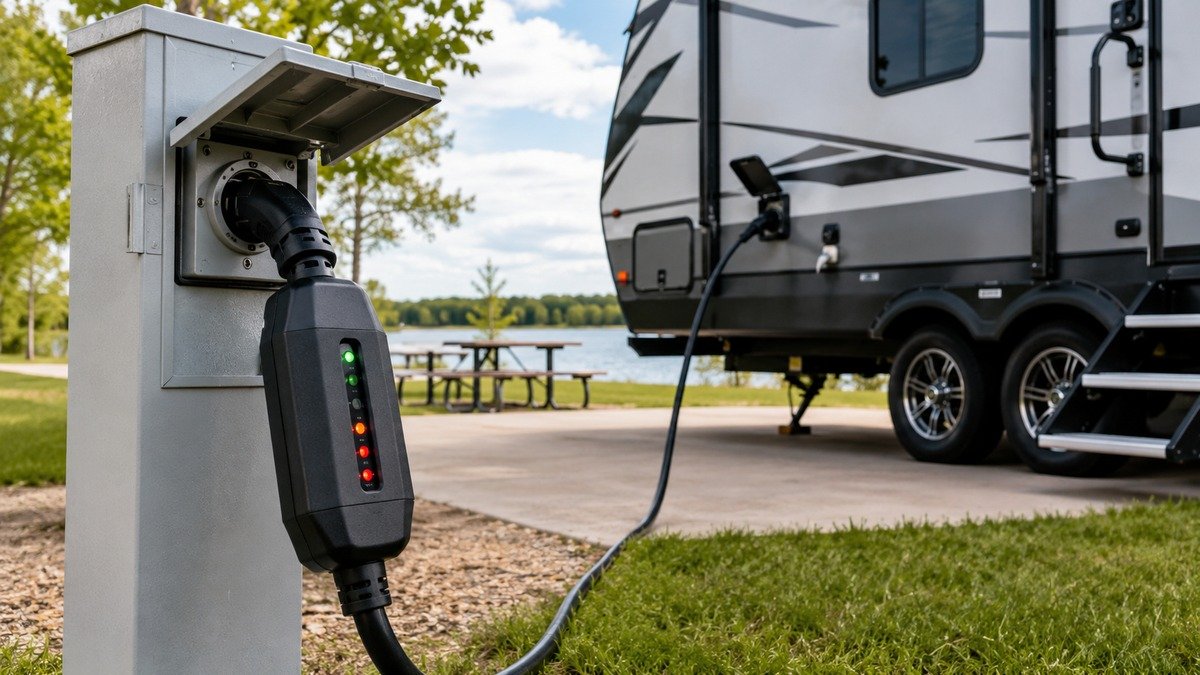
RV Power Protection Checklist Before Plugging Into Campground Power
Use this RV power protection checklist before plugging into campground power to catch common pedestal problems before they reach your RV. A few minutes of inspection and testing can help identify the wrong outlet, damaged connections, unstable voltage, wiring faults, and other conditions that may affect your RV’s electrical system and connected equipment.
Campground power quality can change with electrical demand, weather, aging wiring, and worn connections. Checking the pedestal and using the correct RV power protector can help you avoid connecting to unsafe power.
RV Power Protection Checklist: Before You Connect
Not sure which electrical service your RV uses? See our 30 Amp vs 50 Amp RV Surge Protectors guide before choosing a protector.
1. Confirm Whether Your RV Uses 30 Amp or 50 Amp Service
Start by matching the power protector and campground connection to your RV’s electrical service. Do not choose a protector only because a particular outlet is available at the campsite.
- A 30-amp RV commonly uses a three-prong shore-power plug.
- A 50-amp RV commonly uses a four-prong shore-power plug.
- Check your shore-power cord, RV electrical label, or owner documentation when you are uncertain.
- Use a protector rated for the same amperage and voltage configuration as your RV.
Using the correct amperage is the first step in this RV power protection checklist. A 30-amp protector is not a substitute for a 50-amp model, and a 50-amp protector should not be selected for a 30-amp RV simply because the campsite has a 50-amp receptacle.
2. Inspect the Campground Pedestal Before Plugging In
Before connecting any cord or RV power protector, visually inspect the campground pedestal and receptacle. Do not open the pedestal or attempt electrical repairs yourself.
- Look for cracked, loose, scorched, or melted receptacles.
- Check for corrosion, moisture, insect activity, or debris.
- Make sure the outlet matches the electrical service your RV requires.
- Confirm that the breaker and receptacle appear securely mounted.
- Do not use an outlet that smells burned or shows visible heat damage.
If the pedestal appears damaged, contact campground staff and request another outlet or campsite. An RV surge protector cannot repair a physically damaged receptacle.
3. Connect the RV Power Protector Before the RV
Follow the campground’s procedures and the instructions supplied with your RV and power protector. When the pedestal breaker can be safely switched off, connect the properly rated RV power protector first. Allow it to evaluate the incoming power before connecting or energizing the RV.
A diagnostic RV surge protector may identify pedestal wiring faults and show surge-protection status. A full-protection model can also disconnect power automatically when certain unsafe electrical conditions are detected, depending on the specific model.
4. Wait for the Diagnostic Check to Finish
Do not assume the campground pedestal is safe simply because power is present. Allow the RV power protector to complete its startup sequence, then review its indicator lights, fault chart, or LCD display before connecting or energizing the RV.
Depending on the specific protector, it may check or monitor conditions such as:
- Open ground
- Open neutral
- Reverse polarity
- Miswired campground pedestal
- Missing voltage on one leg of 50-amp service
- Low or high voltage
- Low or high frequency
- Surge-protection status
- Overheating at the plug or receptacle
If the RV power protector reports a fault, do not repeatedly reconnect in an attempt to force power through. Note the displayed condition and contact campground staff before connecting your RV.
5. Verify Voltage Before Applying Large RV Loads
Some full-protection RV power protectors, including the Southwire models covered by this guide, are designed to disconnect power when voltage drops below 102 volts or rises above 132 volts. Power is restored only after acceptable voltage returns and the protector’s reset delay is completed.
After the protector accepts the incoming power, turn on major RV loads gradually instead of energizing every appliance at once. Air conditioners, electric water heaters, microwaves, space heaters, and other high-draw equipment can place a substantial load on campground electrical service.
6. Allow the Reset Delay to Protect the Air Conditioner
Some full-protection RV power protectors include a 128-second reset delay. This delay gives the air-conditioning system time to equalize before power is restored after an interruption, helping protect the compressor from rapid cycling.
Do not bypass the delay or rapidly cycle campground power because the RV does not immediately turn back on. Confirm that the protector is progressing through its normal startup or reset sequence before taking further action.
7. Monitor the Connection During Your Stay
The RV power protection checklist does not end after the initial connection. Electrical conditions can change as campground demand rises, weather changes, or nearby RVs turn high-draw appliances on and off.
- Periodically check the RV power protector for warnings or fault messages.
- Watch for unexpected power interruptions or repeated resets.
- Check the shore-power cord, plug, and connection area for unusual heat.
- Stop using the connection if you notice burning smells, discoloration, smoke, or melting.
- Reduce large electrical loads if voltage becomes unstable.
A protector with continuous voltage and amp-draw monitoring can help you recognize changing campground-power conditions instead of waiting for an appliance, breaker, or electrical connection problem.
When Should You Disconnect From Campground Power?
Disconnect from campground power and contact campground staff when the pedestal or RV power protector indicates a condition that should not be ignored.
- The receptacle is loose, damaged, scorched, or melted.
- The RV power protector reports open ground, open neutral, reverse polarity, or a miswired pedestal.
- Voltage repeatedly falls outside the acceptable operating range.
- The plug, receptacle, cord, or protector becomes unusually hot.
- The protector repeatedly disconnects power after campground staff says the pedestal is operating normally.
- You see smoke, sparks, arcing, or water inside the pedestal area.
Do not attempt to diagnose or repair campground wiring yourself. Move to another approved connection or campsite if campground staff cannot correct the problem.
Choosing the Right Level of RV Power Protection
Not every RV power protector provides the same level of protection. A basic surge protector may provide surge suppression and limited diagnostic indicators. Enhanced-diagnostic models may identify additional campground pedestal faults and overheating conditions. Full-protection models may also disconnect and restore power automatically when certain unsafe electrical conditions are detected.
- Your RV’s 30-amp or 50-amp electrical service
- The electrical conditions you want the protector to monitor
- Portable versus permanently installed operation
- Whether you want voltage and amp-draw monitoring
- Whether automatic power disconnection and restoration are important
Browse our RV surge protectors to compare available protection levels and find options for 30-amp and 50-amp RV electrical systems.
For a side-by-side comparison, read our 30 Amp vs 50 Amp RV Surge Protectors guide.
Recommended RV Power Protectors
Choose a protector that matches your RV’s 30-amp or 50-amp electrical service and the level of diagnostics or automatic protection you want. The options below include portable Southwire Surge Guard models already reviewed for campground-power protection.
Southwire Surge Guard 34931 — 30 Amp Full Protection
For 30-amp RVs, the Southwire Surge Guard 34931 provides full electrical protection with automatic power disconnection and restoration, continuous voltage and amp-draw monitoring, and compatibility with an optional wireless display.
Southwire Surge Guard 34951 — 50 Amp Full Protection
For 50-amp RVs, the Southwire Surge Guard 34951 provides full electrical protection with automatic power disconnection and restoration, continuous voltage and amp-draw monitoring, and compatibility with the optional Southwire 40301 Wireless LCD Display.
Use this RV power protection checklist each time you connect at a new campground, even when the pedestal and receptacle appear to be in good condition.
Need Help Choosing the Right RV Power Protector?
Not sure whether your RV needs 30-amp or 50-amp protection, or whether a diagnostic or full-protection model is the better choice? Include your RV year, make, model, electrical service, and preferred installation style. Our Parts Department can help narrow down the correct RV power protector before you request a quote.

One Comment
Comments are closed.